 Henderson Chris W. and Eileen Narcotta Welp. (2025). Tricorns and Rainbow Flags: Incongruities in US Women National Soccer Team Fandom. In A. Beissel, V. Postlethwaite, A. Grainger, J. Brice (Eds.). The 2023 FIFA Women’s World Cup: Events, Issues, and Controversies. London: Routledge.
This study evaluates the community building practices of United States National Team fans apart from US Soccer’s neoliberal post-feminist empowerment branding and the jingoistic practices of its highest profile fan groups. Organized fan groups in the National Women’s Soccer League, primarily led by queer women, have built inclusive communities centered on their local teams and marginalized identities. While this organized fandom thrives, the same people choose to support the national team in other ways, or not at all. Based on semi-structured interviews with self-identified NWSL fan organizers and our own autoethnographic experiences at the 2015 and 2023 tournaments, we document how fans connect with each other, despite the growing presence of aggressive nationalistic fans. Interlocutors explain their avoidance of US Soccer sanctioned events as well as the colonial symbols and misogynistic practices embodied in other US fandoms. We find that fans who are women, queer, and/or racialized minorities experience a sense of unbelonging in US fan spaces. Despite the presence of jingoistic fans, the core of women’s soccer fans remain confident that the US women’s national team fandom is an inclusive and queer space and will continue to be so.

In US professional soccer, organized fan groups practice a subculture that sustains the lives of marginalized people within the group and provides a platform for resistant politics. In order to materially and ideologically control their spaces and brands from potential disruption, soccer leagues and teams engage with these groups through what we call cultural extraction. The purpose of cultural extraction is to at once depoliticize subculture and capitalize on it by claiming some elements as belonging to the institution and strictly policing others. In this practice, the soccer companies incorporate organized fandom into inclusionary branding in which subcultural practices are reduced to identity-based spectacle in support of the broader cause of consumer-based team support, rather than distinct communities with collective politics. We show how cultural extraction limits American soccer leagues’ efforts to become more tolerant and diverse places by evaluating the public contestations over fan-generated subculture in Portland and Los Angeles.

Liverpool’s elite soccer clubs are at once carefully managed global brands and local institutions infused with community values. As billion-dollar companies, Liverpool FC and Everton FC deploy a tactic we call “branded solidarity”: leveraging the historical enactment of leftist politics in the city to appeal to a broader, global audience through value-laden marketing campaigns that frame the clubs as authentic representations of working-class solidarity. By reducing local traditions to marketable symbols of community, the clubs encounter resistance from fans, who periodically place limits on the capitalist endeavors of the clubs. In this paper, we offer a conjunctural analysis that focuses on the tensions and contradictions of branded solidarity through a close reading of each club’s marketing campaigns and discusses how these tensions played a role in the demise of the short-lived European Super League.
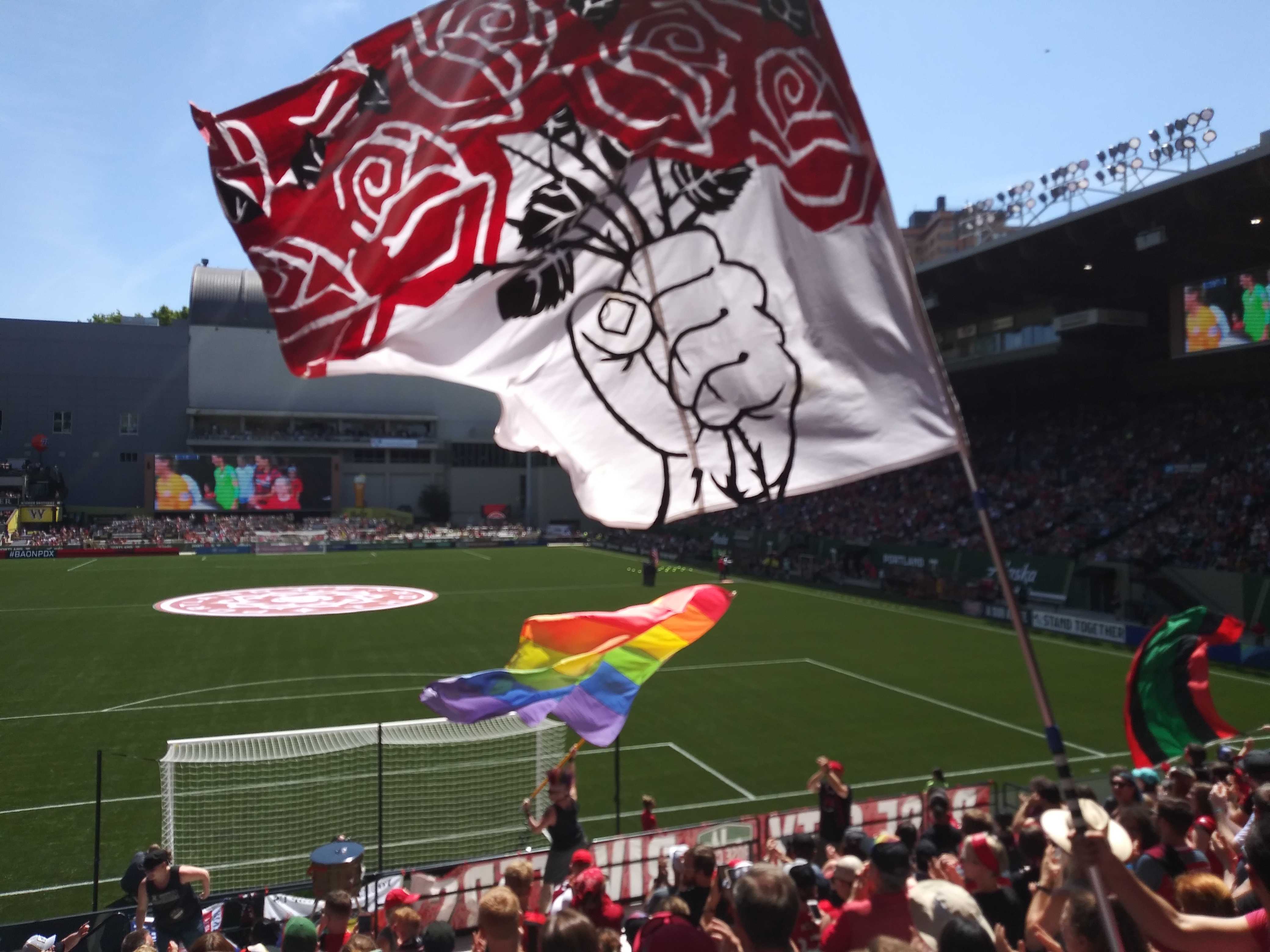
Portland, Oregon’s Rose City Riveters is the largest independent organized supporters group for a women’s soccer team in the world. They support Portland Thorns with an organized, expressive and organic performance of songs, musical instruments and displays that envelopes the entire stadium. Utilizing ethnographic subject-centred methods, this empirical study argues that the group’s performance reflects two different performance lineages, organically organized transnational soccer fandom on one hand and disidentifying queer public performance on the other. This paper explores how different elements of these lineages overlap in the Riveters’ performance to disrupt, negotiate and resist the dominant ideologies of hyper- masculinity and heteronormative femininity that shape professional soccer in the United States.

Building on the context outlined in Stuart Hall’s “The Neoliberal Revolution (2011),” we show how transformations in commodified football in 1980s and 1990s England did not merely reflect larger trends, but were a central site of political innovation constitutive of the country’s larger cultural shifts.
 Chris W. Henderson
You must be logged in to post a comment.